Knowledge center
What is an International Driving Permit?
An International Driving Permit translates your driver's license into a standardized, multi-language format for driving abroad. It's typically needed for renting a car or driving in countries that require one, works alongside your original license, is recognized under the Geneva and Vienna Conventions, and can be applied for online instead of visiting an office in person.
2
governing conventions
A–E
vehicle categories
≤3 yrs
maximum validity
QUICK ANSWER
What is an International Driving Permit?
An International Driving Permit — sometimes searched as an international permit to drive, or simply an IDP — translates the details on your existing driver's license into a standardized, multi-language booklet: your name, photo, license number, and vehicle categories. Its meaning is narrow and specific: it exists so a traffic officer, rental-counter employee, or border official who can't read your license's original language can still verify who you are and what you're licensed to drive.
It doesn't test your driving ability, and it doesn't grant driving rights on its own — it's a translation and identity layer that sits alongside your real license, not a replacement for it.
Important — Same document, several names
At a glance
- Grants driving rights alone
- No
- Must be carried with
- Original license
- Languages
- Multiple
- Vehicle categories covered
- Same as your license
Do you need an International Driving Permit?
It depends on three things: your destination's law, your rental company's own policy, and whether your license is already in a widely-read format — not everyone needs one, and there's no single global rule.
Rental companiesoften request one as their own policy, independent of local law — a company that can't read a foreign license has no fast way to confirm it's valid or match the name against a passport. Some countries write the requirement directly into traffic law, so driving without one can mean being treated as unlicensed. Travelers whose license isn't in a widely-read format— different alphabet, no photo, no Latin transliteration — tend to need one even in places where it isn't strictly required, simply so the license itself is legible.
Important — A real exception worth knowing
Requirements are set per destination, not by a single global rule.
Check your destinationHow to get an International Driving Permit
In the United States, you can get one two ways: in person through AAA or AATA, the two organizations authorized to issue them, or online through an independent preparation service like Apply IDP Online.
What you need to apply
- Valid driver's license
- Required
- Recent photo
- Required
- Signature
- Required
- Minimum age
- 18
The online route is fully remote: securely upload your documents, choose a digital permit or a printed booklet shipped to you, and reach a real person if anything needs attention. Fees and delivery times vary by provider and format.
See the complete step-by-step process, from documents to delivery.
See the full application guideInternational Driving Permit validity
A permit issued under the 1949 Geneva Convention is valid for up to 1 year; one issued under the 1968 Vienna Convention can be valid for up to 3 years. Either way, it stops being valid the moment your underlying driver's license expires, whichever comes first — a longer-validity permit doesn't extend your license's own expiry date.
- Geneva Convention format
- Up to 1 year
- Vienna Convention format
- Up to 3 years
- Always capped by
- Your license's expiry
How an International Driving Permit works
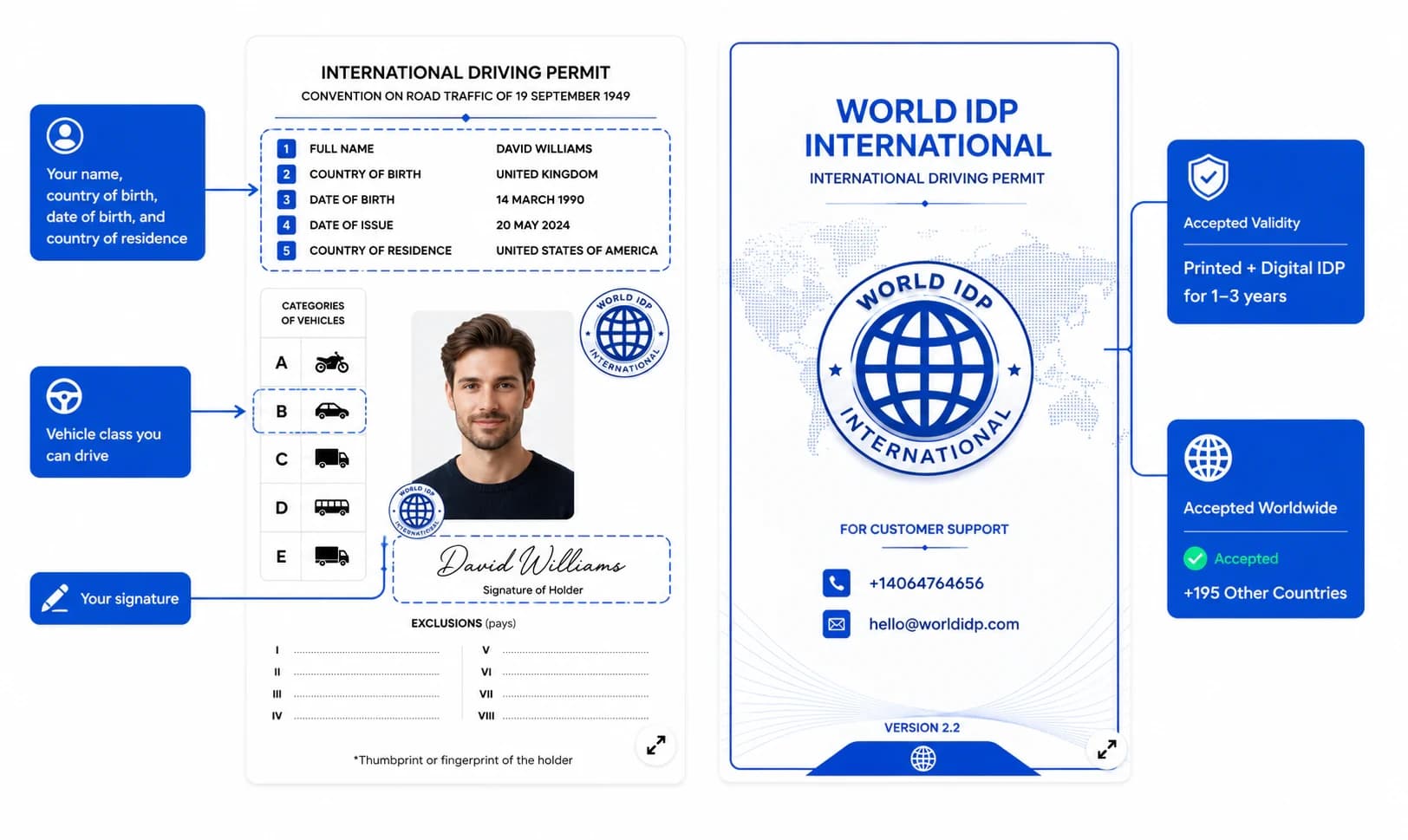
The booklet's layout is standardized so it reads the same way anywhere in the world: an identity page, a vehicle-categories page, and — on a printed copy — a cover stating the validity period and issuing convention.
What the booklet actually looks like
It's a small booklet, roughly passport-photo-page-sized, with a plain cover printed in the issuing country's language, shown above. Open it and the first page is your identity page — name, photo, date of birth, and license number — followed by a vehicle-categories page marking which of A–E your license covers. Both repeat across several language pages, which is exactly what lets the same booklet read correctly whether it's checked in Lisbon or Osaka: the officer isn't translating anything, just reading the language page that matches their own.
Vehicle categories
It lists whatever categories your original license already covers — nothing more. If your license doesn't include motorcycles, your IDP won't either; the permit translates your existing rights, it doesn't expand them.
A — Motorcycle
Mopeds and motorcycles — only shown on your IDP if your original license already covers this category.
B — Car
Standard passenger cars — the category most travelers use for rental cars.
C — Truck
Trucks and heavy goods vehicles above the standard car weight threshold.
D — Bus
Buses and vehicles designed to carry passengers beyond a standard car.
E — With trailer
A trailer combination attached to a category from your original license.
Digital vs. printed
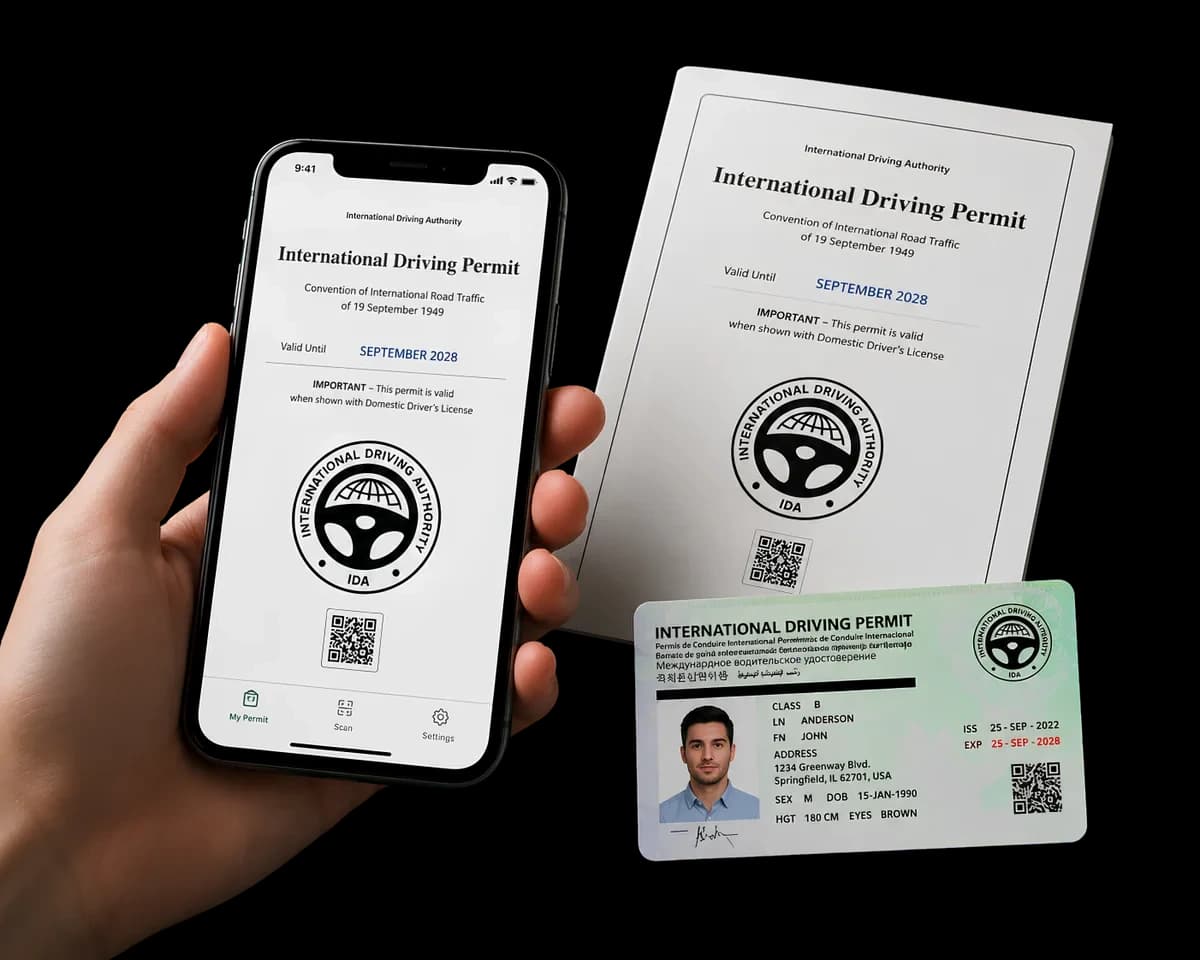
Both formats carry identical legal content and validity dates — the difference is only how you present it. A digital copy travels on your phone and is often enough for identification; some rental counters and traffic officers, especially outside major cities, still prefer the traditional printed booklet. If you're unsure which your destination expects, printed works everywhere digital does, plus a few places it doesn't — and it's a choice you make when you apply, not something your destination locks you into in advance.
IDP vs. other travel documents
An IDP differs from a certified translation, a digital copy of your license, a temporary license, and a foreign license used alone — each solves a different problem, or none at all.
| Document | What it is | Key difference from an IDP |
|---|---|---|
| Your driver's license | The actual legal credential that gives you driving rights. | An IDP has no independent authority — it only translates what your license already grants. |
| A certified translation | A one-off translation from a translator, consulate, or notary. | Not standardized or treaty-backed, so recognition varies far more widely than an IDP's. |
| A digital copy of your license | A photo or scan of your original license. | Still in its original language — it doesn't solve the legibility problem an IDP solves. |
| A temporary or provisional license | A domestic document issued while you wait for your permanent license. | A domestic-only document — it has no international translation function at all. |
| A compliant foreign license alone | Your original license, used abroad without any IDP. | Accepted without an IDP only in specific Vienna Convention cases — the exception, not the default. |
Which of these actually applies to your trip depends on your destination — check its specific requirements.
Why the International Driving Permit exists
It exists because different countries use different alphabets, formats, and languages on their driver's licenses, so governments agreed on a shared, treaty-based translation format instead of leaving every officer or agent abroad to guess. It isn't a product a company invented — it's a document format governments recognize by agreement, which is what makes it work at all.
Paris — International Convention relative to Motor Traffic
The original international framework for cross-border driving documents. Superseded by the Geneva Convention in the countries that later adopted it.
Geneva Convention on Road Traffic
Replaced the 1926 Paris convention. Currently has 102 contracting parties — still the version most widely recognized worldwide.
Vienna Convention on Road Traffic
A newer treaty that, between its own contracting parties, supersedes Geneva. Added vehicle subcategories and modernized formatting the 1949 version didn't have.
Vienna succeeded Geneva to reflect growing international travel and more detailed vehicle categories — but since both treaties are still active today, the same question, “is my IDP valid here?”, can have a different answer depending on which one your destination is party to.
Where it's recognized
Recognition follows the same convention logic explained above: a country party to the Vienna Convention recognizes Vienna-format IDPs; that isn't automatically true for a country that's only party to Geneva, or to neither. Local practice and rental-company policy add a further layer on top of that legal baseline.
Recognition at a glance
- Vienna Convention destinations
- Recognize Vienna-format IDPs
- Geneva-only destinations
- May not recognize Vienna format
- Rental-company policy
- Can require more than local law
How travelers actually use an International Driving Permit during a trip
It comes into play at specific points on a trip, not continuously — here's the order they actually happen in.
Before you travel: pack it with your original license and keep a digital backup of both — nothing to declare or activate before departure.
At airline check-in: airlines check your passport and visa, not your IDP. It isn't a boarding requirement, so there's nothing to show until you're actually driving.
Crossing a border: an officer may glance at it alongside your passport, but it's rarely scrutinized closely since it isn't an entry or visa document — its role starts once you're behind the wheel.
At the rental counter
The agent checks the name and photo match and that your IDP's vehicle category covers the car you're renting — it just makes the license part of check-in fast.
During a police stop
If the officer can't read your license, your IDP is what lets them verify your name, photo, and categories without a translator. Local traffic law still applies exactly as it would for a resident driver.
For your insurance file
An IDP itself provides no coverage. If a claim ever involves a foreign license, some insurers do reference IDP status, so check your specific policy rather than assuming either way.
Expert note — What verification actually checks
Common mistakes
Most problems travelers run into aren't about the document itself — they're about timing and assumptions. These four account for nearly everything that goes wrong.
Applying too close to your license's expiry
Your IDP's validity is capped by your original license's expiry date, whichever comes first. A permit issued days before your license expires won't cover a return trip months later.
Leaving the original license at home
Officials and rental agents can refuse to proceed without it — some will hold your booking while you sort it out, others will decline the rental outright, and neither outcome is guaranteed reversible on the spot.
Assuming a rental company's request is a legal requirement
A rental company can ask for an IDP as its own policy even where local law doesn't require one, and vice versa. Check both separately rather than assuming one implies the other.
Trusting a seller that promises validity beyond 3 years
No convention allows more than 3 years of validity. A longer promise isn't a better deal — it's a reason to double-check who you're buying from.
Common myths
These four misconceptions cause most of the confusion — and the most avoidable mistakes.
Myth
An International Driving Permit is a license you can drive on by itself.
Fact
It has no independent authority. It's a translation and identity document that must be carried together with your valid original driver's license at all times.
Myth
"International Driver's License" is a different, possibly fake document from an IDP.
Fact
It's the same document. "International Driving Permit" is the official term from the Geneva and Vienna conventions; "International Driver's License" is simply the common phrase most people search for.
Myth
It has security features like holograms to prevent forgery, similar to a passport.
Fact
It doesn't. Legitimacy relies on the issuing organization and the standardized format, not physical security features — which is exactly why checking who issued yours matters more than what it looks like.
Myth
Any IDP is accepted everywhere in the world.
Fact
Recognition depends on which convention (if any) your destination is party to, and on local or rental-company policy. Coverage is wide but not universal.
What to do before your trip
Getting ready comes down to five checks.
Confirm what your destination actually requires — legal requirement, common request, or neither. Check →
Make sure your original license has enough validity left to cover your entire trip, not just the day you apply.
Decide digital or printed based on where you're going — printed covers a few more places, digital is faster to have on hand.
If your destination cares which convention issued your IDP, confirm which format your provider uses before you apply.
Keep a photo or digital backup of both documents somewhere separate from the originals.
You've covered the fundamentals — starting your application takes about the same time as reading this page.
Start your applicationReady to prepare your International Driving Permit?
You know what it is, why it exists, and what to check before your trip. The application itself takes just a few minutes.
Start application